
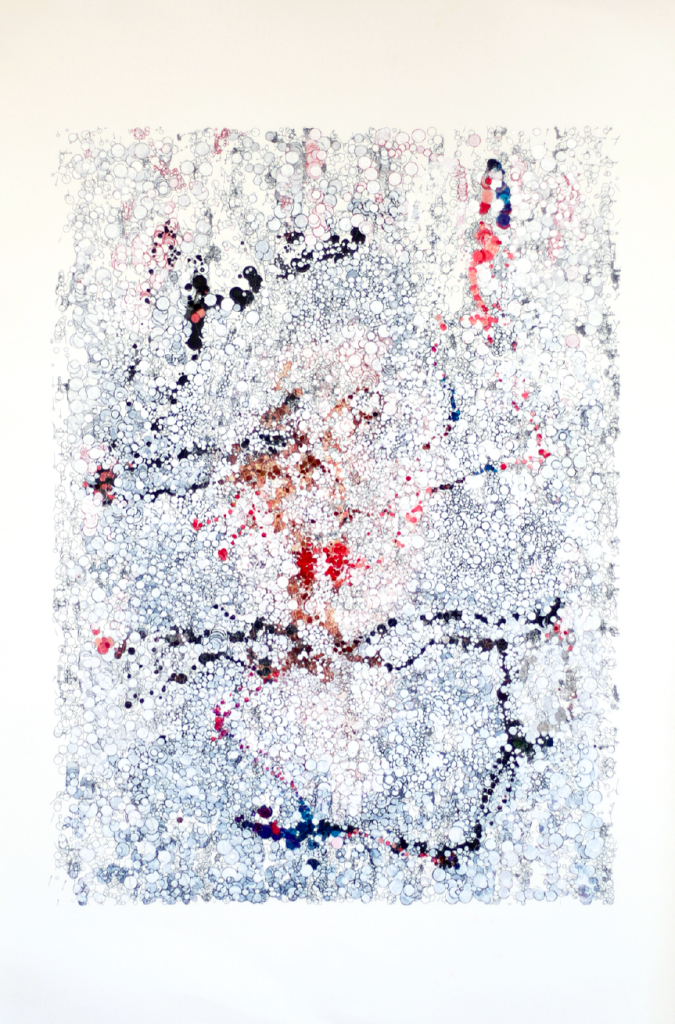
MARIANO SARDÓN
in collab. with MARIANO SIGMAN
The paths of Almudena
2025
Eye-tracking data from 39 observers, recorded over 3.7 seconds. Customized visualization algorithm.
Oil pastel and acrylic on digital print. BFK Rives paper.
120 x 80 cm / 47 × 31.5 in
Price: 6500 €
ABOUT THE WORK
Mariano Sardón’s artistic practice stems from an interest in the processes through which we perceive, organize, and transform reality into image. At the center of his research is the gaze: understood not simply as the act of seeing, but as a dynamic process in which light, movement, memory, and attention contribute to the construction of what we recognize as reality.
Read the full text
In this journey, Sardón has developed a long-standing collaboration with the Argentine neuroscientist Mariano Sigman, aimed at exploring the relationship between visual perception, brain activity, and the production of images. The collaboration between artist and scientist does not consist in the mere application of scientific tools to art, but in the construction of a common ground in which neuroscientific research becomes material for aesthetic experimentation.
Through eye-movement recording systems, Sardón and Sigman observe what normally remains invisible: the trajectory of the gaze, fixation points, the duration of attention, the speed of eye movements. The seemingly continuous act of seeing is thus broken down into a succession of data, micro-events, and variations. The gaze ceases to be merely that through which we observe the world and becomes itself an object to be observed.
It is from this data that Sardón builds his works. Information from the perceptual process is translated into lines, color fields, forms, traces, and visual configurations. Here, technology does not serve to faithfully reproduce what the eye sees, but to make visible the process through which vision takes shape.
The works thus call into question the idea of a stable and definitive image. What we perceive as continuous, solid, and permanent is the result of an extremely rapid processing of information: the retina receives light, the eye moves, attention selects, memory intervenes, and the brain organizes these elements into a coherent representation. The image we call reality is, in this sense, a construction.
In Sardón’s research, scientific data does not remain data: it is transformed. The traces of the gaze become pictorial material; the coordinates of movement become composition; the recording of a physiological process is converted into an autonomous image. It is precisely in this passage — from measurement to form, from data to perception, from science to aesthetic experience — that the specificity of his practice is defined.
The collaboration with Mariano Sigman is therefore a fundamental component of this journey, but it is within Mariano Sardón’s artistic research that these materials find their definitive form. Neuroscience provides tools, questions, and modes of observation; art reworks them through a practice that restores to the data their sensitive and ambiguous dimension.
Each work thus becomes a sort of landscape of the gaze: a visualization of what happens in the infinitesimal interval between the world we observe and the image our mind constructs. Sardón invites us to look not only at what we see, but at the very process of seeing.
Reality, in his works, does not appear as something immutable, but as an event in continuous formation. A set of data, movements, selections, and memories that, for an instant, takes the form of an image.

Installation view
SHORT BIO
Mariano Sardón (Bahía Blanca, Argentina, 1968) is an artist and researcher working at the intersection of art, science, and technology. Combining traditional and new media, data visualization, and computer languages, he creates installations that explore perception, the body, and cognitive processes, some in collaboration with scientists.
He studied Physics at the University of Buenos Aires and is an associate artist at the Munich Interactive Intelligence Initiative (Mi3). He has been a mentor and jury member at the European ARTificial Intelligence Lab, Ars Electronica Center.
His awards include the ARCO/BEEP Award for Electronic Arts (ARCO Madrid, 2019), the Konex Award in Visual Arts (2012), and the Experimentation Award in Non-Traditional Media and Video from the Argentine Association of Art Critics (2008). He has lectured at the Centre Pompidou, ZKM Karlsruhe, and Ars Electronica Center, among others.
His work has been shown at the 57th Venice Biennale (2017), Palazzo Fortuny, Ars Electronica Linz, the Pushkin Museum in Moscow, the 11th Havana Biennial, MALBA, MAMBA, Fundación PROA, and in galleries and fairs including Ruth Benzacar, Artericambi, Bryce Wolkowitz, ARCO, and Artissima. FULL BIOGRAPHY HERE